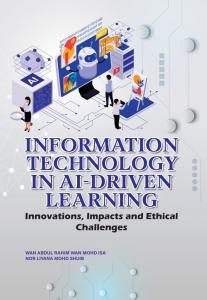
INFORMATION TECHNOLOGY IN AI-DRIVEN LEARNING INNOVATIONS, IMPACTS AND ETHICAL CHALLENGES
Keywords:
Futuristic, frontier, teaching, learningSynopsis
The convergence of Artificial Intelligence and Information Technology is fundamentally reshaping the educational landscape. Information Technology in AI-Driven Learning: Innovations, Impacts and Ethical Challenges offers an essential guide to this digital transformation. Using a narrative review methodology, this research book provides a holistic synthesis of this new territory. It moves beyond fragmented discussions to connect IT innovations from adaptive platforms to intelligent tutoring systems with their real-world impacts on learners. Crucially, it confronts the critical ethical challenges that arise, from algorithmic bias and data privacy to the governance of AI in our institutions. Across its eight interconnected chapters, this volume integrates theory and empirical findings, providing educators, researchers, and policymakers with a clear roadmap for harnessing AI responsibly. This book advocates for a humancentered integration of technology guided by equity and the enduring goal of enriching human learning experiences.
Downloads
Download data is not yet available.
References
Abdul Rahim, S. A., Sidi, F., Affendey, L. S., Ishak, I., & Nurlankyzy, A. Y. (2024). Leveraging data lake architecture for predicting academic student performance. International Journal on Advanced Science, Engineering and Information Technology, 14(6), 2121-2129. https://doi.org/10.18517/ijaseit.14.6.12408
Abdulahi, A. A., Olakunle, O. A., Olalekan, B. H. (2024). The impact of personalized AI-driven learning paths on student engagement and academic performance in University of Ilorin, Ilorin. International Journal of Innovative Technology Integration in Education, 7(2), 1-11. https://ijitie.aitie.org.ng/index.php/ijitie/article/view/313
Afzaal, M., Nouri, J., Zia, A., Papapetrou, P., Fors, U., Wu, Y., Li, X., & Weegar, R. (2021). Explainable AI for data-driven feedback and intelligent action recommendations to support students’ self-regulation. Frontiers in Artificial Intelligence, 4(723447). https://doi.org/10.3389/frai.2021.723447
Afzal, S., Dhamecha, T., Mukhi, N., Sindhgatta, R., Marvaniya, S., Ventura, M., & Yarbro, J. (2019). Development and deployment of a largescale dialog based intelligent tutoring system. In Proceedings of the 2019 Conference of the North American Chapter of the Association for Computational Linguistics: Human Language Technologies, Volume 2 (Industry Papers), (pp. 114–121). Minneapolis, Minnesota. Association for Computational Linguistics.https://doi.org/10.18653/V1/N19-2015
Ahmed Dahri, N., Yahaya, N., Al-Rahmi, W. M., Almuqren, L., Almgren, A. S., Alshimai, A., & Al-Adwan, A. S. (2025). The effect of AI gamification on students’ engagement and academic achievement in Malaysia: SEM analysis perspectives. IEEE Access, 13, 70791-70810. https://doi.org/10.1109/access.2025.3560567
Alalawi, K., Athauda, R., & Chiong, R. (2024). An extended learning analytics framework integrating machine learning and pedagogical approaches for student performance prediction and intervention. International Journal of Artificial Intelligence in Education, 35, 1239-1287. https://doi.org/10.1007/s40593-024-00429-7
Alawneh, Y. J. J., Radwan, E. N. Z., Salman, F. N., Makhlouf, S. I., Makhamreh, K., & Alawneh, M. S. (2024). Ethical considerations in the use of AI in primary education: Privacy, bias, and inclusivity. 2024 International Conference on Knowledge Engineering and Communication Systems (ICKECS), Chikkaballapur, India, 2024. (pp. 1-6). https://doi.org/10.1109/ickecs61492.2024.10616986
Aler Tubella, A., Mora-Cantallops, M., & Nieves, J. C. (2024). How to teach responsible AI in higher education: Challenges and opportunities. Ethics and Information Technology, 26(3), 1-14. https://doi.org/10.1007/s10676-023-09733-7
Al-Fraihat, D., Joy, M., Masa’deh, R., & Sinclair, J. (2020). Evaluating e-learning systems success: An empirical study. Computers in Human Behavior, 102, 67-86. https://doi.org/10.1016/j. chb.2019.08.004
Ali, Z. (2025). Artificial intelligence in education: Applications, challenges, and future directions – A critical review. International Journal of Ethical AI Application. 1(3), 49-55. https://doi. org/10.64229/88956k15
Alqurashi, E. (2019). Predicting student satisfaction and perceived learning within online learning environments. Distance Education, 40(1), 133-148. https://doi.org/10.1080/01587919.2018. 1553562
Downloads
Published
13 April 2026
Versions
- 13-04-2026 (2)
- 19-05-2026 (1)
Categories
Copyright (c) 2026 Penerbit UTHM
Details about this monograph
ISBN-13 (15)
978-629-490-300-5
Physical Dimensions
How to Cite
Wan Abdul Rahim Wan Mohd Isa, & Nor Liyana Mohd Shuib. (2026). INFORMATION TECHNOLOGY IN AI-DRIVEN LEARNING INNOVATIONS, IMPACTS AND ETHICAL CHALLENGES. Penerbit UTHM. https://publisher.uthm.edu.my/omp/index.php/penerbituthm/catalog/book/594 (Original work published 2026)