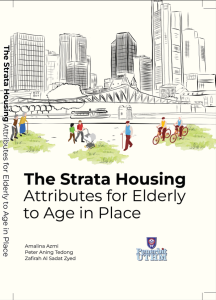
The Strata Housing Attributes for Elderly to Age In Place
Keywords:
Elderly, housing attributes, residential safety, strata housingSynopsis
As we navigate the journey of life, we encounter myriad experiences that shape who we are. Each stage brings new challenges and triumphs, and the process of ageing is no different. Ageing in place has becoming a popular trend among the elderly whereby they insist on growing older in a familiar place especially at their own house. Despite of their impairments, they prefer to ageing in place. Added to that, in line with the rapid urbanisation, they might ageing in place in a highrise building such as condominiums and apartments. However, this trend has triggered concerns among family members, such as, how safe are their parents or grandparents in their own homes?
Thus, this book will delve into the high-rise building attributes that enable the elderly to age in place. Surveys and interviews were conducted among elderly individuals with impairments to gather input on the required high rise building attributes for them to age in place. Throughout the pages of this book, you will encounter diverse perspectives and experiences that illuminate the many-sided nature of ageing in place which contributes to 3 types of high-rise building attributes which are internal attributes, external attributes, and technology attributes. Together, we can create a nation that allows everyone to age gracefully, independently, and safely in either condominiums or apartments. May this book inspire us to envision and build a future where ageing in place in either condominiums or apartments is not only a possibility but a cherished reality for all.
Downloads
Download data is not yet available.
References
Aarts, Mariëlle P. J., Janny C. Stapel, Toine A. M. C. Schoutens, and Joost van Hoof. 2018. “Exploring the Impact of Natural Light Exposure on Sleep of Healthy Older Adults: A Field Study.” Journal of Daylighting 5(1):14–20.
Abd-Wahab, S., A. Sairi, A. I. Che-Ani, N. M. Tawil, and S. Johar. 2015. “Building Maintenance Issues: A Malaysian Scenario for High-Rise Residential Buildings.” International Journal of Applied Engineering Research 10(6):15759–76.
Abdel Salam, Mahmoud, and Amal Shams El-din. 2019. “Developing Smarter Bathrooms for Elderly and Disabled People.” Journal of Al-Azhar University Engineering Sector 14(52):1024–35.
Abdul Kadir, Syazwani, Mariam Jamaludin, and Asiah Abdul Rahim. 2012. “Building Managers’ Perception in Regards to Accessibility and Universal Design Implementation in Public Buildings: Putrajaya Case Studies.” Procedia - Social and Behavioral Sciences 35(December 2011):129–36.
Abd Malik, Sofianiza and Azuddin Muna. 2013. “Qualitative Findings on the Use of Mobile Phones by Malaysian Older People.” Pp. 435–39 in Proceedings - 2013 International Conference on Advanced Computer Science Applications and Technologies, ACSAT 2013.
Abdul Manaf, M. Rizal, Madihah Mustafa, Mohd Rizam Abdul Rahman, Khairul Hazdi Yusof, and Noor Azah Abd Aziz. 2016. “Factors Influencing the Prevalence of Mental Health Problems among Malay Elderly Residing in a Rural Community: A Cross-Sectional Study.” PLoS ONE 11(6):1–12.
Downloads
Published
1 May 2025
Categories
Copyright (c) 2025 Penerbit UTHM
Details about this monograph
ISBN-13 (15)
978-629-490-158-2
How to Cite
Amalina Azmi, Peter Aning Tedong, & Zafirah Al Sadat Zyed. (2025). The Strata Housing Attributes for Elderly to Age In Place. Penerbit UTHM. https://publisher.uthm.edu.my/omp/index.php/penerbituthm/catalog/book/575