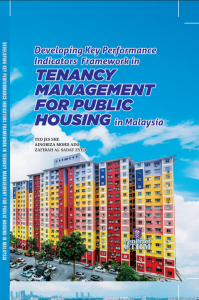
Developing Key Perfomance Indicators Framework in Tenancy Mangement for Public Housing in Malaysia
Keywords:
Public housing, tenancy, housing policy, Delphi managementSynopsis
Effective performance measurement (PM) is a crucial element in ensuring the success and sustainability of public housing management. While Malaysia’s public housing sector has made notable strides in building maintenance and facility management, the vital area of tenancy management remains underexplored. This book brings to the forefront the importance of monitoring tenancy-related functions—ranging from unit allocation and rent collection to tenant relations and neighborhood issues—as an integral part of overall housing performance. Drawing on international perspectives and local realities, this work highlights the emerging trends of Externalization, Reconceptualization, and Managerialization as frameworks for improving tenancy management. Among these, Managerialization stands out for its structured, goal-oriented approach. However, Malaysia's current PM efforts often overlook the tenant-level dynamics essential to achieving holistic housing outcomes. Through a rigorously designed mixed-method study grounded in pragmatism, this book introduces a tailored set of Key Performance Indicators (KPIs) specifically for tenancy management in Malaysia’s public housing context. Employing the Delphi method, expert interviews, and successive rounds of surveys, the research identifies and validates 51 critical KPIs. These indicators are further analyzed using the Importance-Practicality Quadrant Analysis (IPQA) to determine their real-world applicability and impact. A key contribution of this book is the integration of a "Social Perspective" into the Balanced Scorecard (BSC) model—an innovation that addresses the broader societal role of public housing. By framing tenancy performance within this expanded model, the book provides a more comprehensive tool for policy evaluation, transparency, and equitable service delivery.
This book serves as an essential guide for housing administrators, policymakers, and researchers seeking to advance the quality and accountability of tenancy management in Malaysia’s public housing sector. It not only fills a critical gap in existing PM literature but also paves the way for future improvements that align with the social and operational realities of public housing.
Downloads
Download data is not yet available.
References
Abdullah, Y. A., Kuek, J. N., Hamdan, H., & Mohd Zulkifli, F. L. (2017). Combating squatters in Malaysia: Do we have adequate policies as instruments? Planning Malaysia, 15(2), 51-62. https://doi.org/10.21837/pm.v15i2.263
Achour, I., & Bichari, K. (2019). Improving public sector organizations’ performance through the application of benchmarking: TRADE benchmarking model case studies from Dubai public sector organizations. Journal of Economic Sciences, Management & Commercial Sciences (JESMCS), 12(3), 34-47.
Adegbembo, T. (2022). The importance and use of key performance indicators of knowledge management in quantity surveying firms in Nigeria. Journal of Surveying, Construction and Property (JSCP), 13(1), 76-89. https://doi.org/10.22452/jscp.vol13no1.5
Adewunmi, Y. A., Iyagba, R., & Omirin, M. (2017). Multi-sector framework for benchmarking in facilities management. Benchmarking: An International Journal, 24(4), 826–856. https://doi.org/10.1108/BIJ-10-2015-0093
Adler, M., & Ziglio, E. (1996). Gazing into the oracle: The Delphi method and its application to social policy and public health. Jessica Kingsley Publishers.
Ahmed, Y., Atan, I., Sipan, B., Binti, H., & Hashim, A. (2020). Publicprivate partnership strategy for housing provision in Abuja, Nigeria. International Journal of Scientific & Technology Research, 9(1), 1958–1965. http://www.ijstr.org
Downloads
Published
1 August 2025
Categories
Copyright (c) 2025 Penerbit UTHM
Details about this monograph
ISBN-13 (15)
978-629-490-194-0
How to Cite
Teo Jes She, Ainoriza Mohd Aini, & Zafirah Al Sadat Zyed. (2025). Developing Key Perfomance Indicators Framework in Tenancy Mangement for Public Housing in Malaysia. Penerbit UTHM. https://publisher.uthm.edu.my/omp/index.php/penerbituthm/catalog/book/560