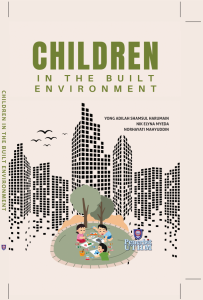
Children In The Built Environment
Keywords:
Built environment, urban planning, play spaces, accessibility, inclusionSynopsis
“Children in the Built Environment” is a work of passion that was authored by three researchers in the field of Built Environment who are profoundly dedicated to enhancing the urban environments in Malaysia for children. Each author contributes a distinctive perspective, which is inspired by a common goal to promote child-friendly environments that facilitate the development and experiences of children in urban environments. This book addresses the necessity of revised design guidelines that guarantee that play spaces are both accessible and inviting for all children, including those with disabilities, and that they support physical, emotional, and cognitive development. Vehicular movement and economic growth are frequently prioritised over the overall well-being of younger residents, walkability, and playability in contemporary planning principles. Consequently, the number of children's playgrounds, open spaces, and parks is frequently insufficient, and they are either inadequately maintained or situated in areas that are unsafe for children to access.
This book also explores the vital transformation of Malaysia's urban spaces into environments that are genuinely child-friendly - an endeavour that demands strong political will and commitment from both local and federal governments. Central to this transformation is investment in sustainable practices and consistent maintenance, alongside the coordination of built environment facilities that not only comply with regulatory standards but also promote well-being, accessibility, and inclusivity. This includes facilities design for accessibility and inclusion and sustainable practice for inclusive facilities. additionally, the book underscores the critical importance of indoor air quality in safeguarding the health and well-being of children. Infrastructure development must be consistent with the UN Convention on the Rights of the Child (UNCRC), and participatory planning processes with children and carers must be made possible. In order to guarantee that every child can develop, play, and flourish in secure, nurturing environments that prioritise both interior and outdoor quality, it is imperative to promote government leadership, cross-agency collaboration, and sustained community engagement.
This book functions as both a guide and a call to action, providing inspiration, strategies, and insights for the transformation of urban spaces into environments that prioritise the needs of children and uphold their rights in Malaysia and around the globe.
Downloads
Download data is not yet available.
References
Ab Wahab, L., Ismail, K., Lop, N. S., & Hanid, M. (2022). Accessibility and inclusivity of playgrounds for children with disabilities in Malaysia. Planning Malaysia, 20(3), 172–183. https://doi.org/10.21837/pm.v20i22.1136
Adams, S., & Savahl, S. (2017). Nature as children's space: A systematic review. The Journal of Environmental Education, 48(5), 291– 321.
Ager, A., Metzler, J., Vojta, M., & Savage, K. (2013). Child friendly spaces: A systematic review of the current evidence base on outcomes and impact. Intervention, 11(2), 133–147.
Ahmad Zawawi, Z., Kamarudin, H., Mohammad Ali, I., & Narotama, M. R. (2024). The needs of accessibility audit in facilities management for improving inclusive access. Malaysian Journal of Sustainable Environment, 11(3), 125–144. https://doi.org/10.24191/myse.v11i3.3913
Al-Ajmi, F. F., Loveday, D. L., Bedwell, K. H., & Havenith, G. (2008). Thermal insulation and clothing area factors of typical Arabian Gulf clothing ensembles for males and females: Measurements using thermal manikins. Applied Ergonomics, 39(3), 407–414. https://doi.org/10.1016/j.apergo.2007.10.001
Allen, N. (2015). Understanding the importance of urban amenities: A case study from Auckland. Buildings, 5(1), 85-99.
Downloads
Published
1 August 2025
Categories
Copyright (c) 2025 Penerbit UTHM
Details about this monograph
ISBN-13 (15)
978-629-490-186-5
How to Cite
Yong Adilah Shamsul Haramain, Nik Elyna Myeda, & Norhayati Mahyuddin. (2025). Children In The Built Environment. Penerbit UTHM. https://publisher.uthm.edu.my/omp/index.php/penerbituthm/catalog/book/556