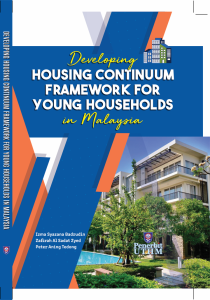
Developing House Continuum Framework for Young Households in Malaysia
Keywords:
Housing affordability, housing pathways, young households, continuum frameworkSynopsis
The concern over housing affordability gained substantial momentum especially among young households (YH) in Klang Valley (KV), despite various incentives and schemes been introduced by government. Hence, through housing pathways approach by David Clapham, this study aimed to develop Housing Continuum Framework (HCF) to mitigate the housing affordability problems among YH in KV. Generally, HCF is a concept that is used to depict the spectrum of housing options available in the housing market, ranging from emergency or homeless shelter to private homeownership. Three main research objectives addressed. Firstly, to identify the components of HCF. Secondly, to investigate the housing affordability problems among YH in KV. Thirdly, to examine the role of stakeholders and lastly, to develop HCF. This study developed insights from mixed methods research by using concurrent triangulation. Drawing upon case study from YH in KV, questionaire survey was conducted amongst 400 respondents age 20 to 39 through simple random sampling and was analysed using SPSS. By using Spearman correlation analysis, it can be sum up that there is a correlation between housing price and household income, yet there is no correlation between housing price, household income with housing choice. The in-depth interview was conducted with nine housing stakeholders to answer the third research questions and was analysed using thematic analysis. With information from both methods, HCF was developed using the housing pathways approach. All housing types were arranged in the form of linear. The purpose is to address the housing affordability problems in more holistic ways from homeless shelter to private housing market.
Downloads
Download data is not yet available.
References
Aarland, K., & Reid, C. K. (2019). Homeownership and residential stability: Does tenure really make a difference? International Journal of Housing Policy, 19(2), 165-191.
Abdullah, Y. A., Kuek, J. N., Hamdan, H., & Zulkifli, F. L. M. (2017). Combating squatters in Malaysia: Do we have adequate policies as instrument? Planning Malaysia, 15(2), 25-36.
Ab Rahim, N., Adzhar, S. M., Basrah, N., Ab Majid, R., & Mustafar, S. (2019). Factors lead to overhang in affordable housing: A content analysis in qualitative approach. In IOP Conference Series: Earth and Environmental Science (Vol. 385, No. 1, p. 012073). IOP Publishing.
Adib, N. A. M., Hussin, Z. H., & Ahmad, Y. (2016). Homeless women in Malaysia: Their choice or victims of situations. Journal of Education and Social Sciences, 5(3), 8-15.
Ahmad, F., Abd Aziz, W. N. A. W., Hanif, N. R., & Ahmad, I. M. (2012). Home owning democracy for the urban poor: A case study of Kuala Lumpur, Malaysia. Journal of Sustainable Development, 5(1), 13.
Ahmad, Z., & Zain, Z. M. (2021). Political Involvement among Youth in Malaysia: Lessons Learnt. International Journal of Media and Communication Research (IJMCR), 2(1), 11-22.
Afiqah, N., Bahrin, N. E. S. K., & Rozman, A. T. (2020). Housing affordability preferances for “Rumah Selangorku” scheme.
Downloads
Published
1 December 2024
Categories
Copyright (c) 2024 Penerbit UTHM
Details about this monograph
ISBN-13 (15)
978-629-490-125-4
Physical Dimensions
How to Cite
Izma Syazana Badrudin, Zafirah Al Sadat Zyed, & Peter Aning Tedong. (2024). Developing House Continuum Framework for Young Households in Malaysia. Penerbit UTHM. https://publisher.uthm.edu.my/omp/index.php/penerbituthm/catalog/book/554