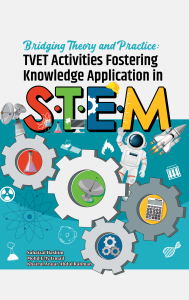
BRIDGING THEORY AND PRACTICE: TVET ACTIVITIES FOSTERING KNOWLEDGE APLLICATION IN STEM
Keywords:
TVET, STEM, Context, technologySynopsis
The purpose of this book is to provide educators, students, and parents with guidance on the role of Technical and Vocational Education (TVET) in STEM (Science, Technology, Engineering, And Mathematics) education. Specifically, it addresses how to implement current trends in the classroom, particularly when it comes to TVET-STEM activities in Malaysia. This paper aims to give an overview of TVET’s role in STEM education, which is to help people discover and develop their educational potential, career, and psychology in order to reach an optimal level of social motivation and personal development. This is in accordance with the needs of 21st-century education and the realization that many educators, parents, and students are still unsure about this role. The progress of STEM education is greatly aided by TVET. Generally speaking, TVET allows students to apply STEM concepts in real-world contexts through experiential learning. This aids in their integration of STEM concepts with practical, industrial uses. Furthermore, TVET offers a different kind of education for people who cannot or will not pursue postsecondary education in STEM fields. This enables people to get practical skills in a range of STEM fields, including as mechanical, electrical, and information technology, without needing to pursue an extensive academic degree.
Downloads
Download data is not yet available.
References
Adnan, M. H. M., Ariffin, S. A., Hanafi, H. F., Husain, M. S., & Panessai, I. Y. (2020). A Social Media Analytics Framework to Increase Prospective Students’ Interests in STEM and TVET Educationx. Asian Journal of University Education, 16(4), 82–90. https://doi.org/10.24191/ajue.v16i4.11945
Akgunduz, D., & Mesutoglu, C. (2021). Science, Technology, Engineering, and Mathematics Education for Industry 4.0 in Technical and Vocational High Schools: Investigation of Teacher Professional Development. Science Education International, 32(2), 172-181.
Baharin, N., Kamarudin, N., & Manaf, U. K. A. (2018). Integrating STEM education approach in enhancing higher order thinking skills. International Journal of Academic Research in Business and Social Sciences, 8(7), 810-821.
Bakar, A.Y.A., & Mahmud, M.I. (2020). The Profiling of Aspiration and Interest towards STEM and TVET Careers among Malaysian School Students. Journal for the Education of Gifted Young Scientists, 8(1), 489-500.
Campbell, C., & Rolls, J. (2017). Retracted Article: Fostering student persistence on TVET pathways through mutual adaptation: a case study of Qatar.
Chondrogiannis, E., Symeonaki, E., Papachristos, D., Loukatos, D., & Arvanitis, K. G. (2021). Computational thinking and STEM in agriculture vocational training: A case study in a Greek vocational education institution. European Journal of Investigation in Health, Psychology and Education, 11(1), 230-250.
DePryck, K., & Wambacq, I. (2023). Digital Competences of TVET Educators. e-Assessment in the context of DigCompEdu. In Society for Information Technology & Teacher Education International Conference (pp. 476-483). Association for the Advancement of Computing in Education (AACE).
Dougherty, S.M., & Macdonald, I.H. (2020). Can growth in the availability of STEM technical education improve equality in participation: Evidence from Massachusetts.
Grant, A. D., Swan, K., Wu, K., Plenty Sweetgrass-She Kills, R., Hill, S., & Kinch, A. (2022). A Research Publication and Grant Preparation Program for Native American Faculty in STEM: Implementation of the Six R’s Indigenous Framework. Frontiers in Psychology, 12(February). https://doi.org/10.3389/fpsyg.2021.734290
Hwong, Y., & Hung, B. (2021). Effectiveness of STEM Activities to enhance TVET for a Sustainable Fashion Textile and Clothing Industry. Implementation of STEM in Teaching and Learning Process. Global Journal of Educational Research and Management (GERMANE) 2022, 2(1), 252–269
Published
1 March 2026
Copyright (c) 2026 Penerbit UTHM
Details about the available publication format: PDF
PDF
ISBN-13 (15)
978-629-490-270-1
Physical Dimensions
How to Cite
Suhaizal Hashim, Mohd Erfy Ismail, & Khairul Anuar Abdul Rahman. (2026). BRIDGING THEORY AND PRACTICE: TVET ACTIVITIES FOSTERING KNOWLEDGE APLLICATION IN STEM. Penerbit UTHM. https://publisher.uthm.edu.my/omp/index.php/penerbituthm/catalog/book/531