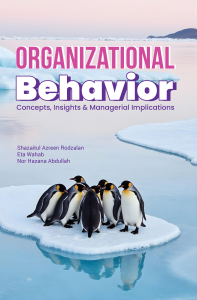
ORGANIZATIONAL BEHAVIOR CONCEPTS, INSIGHT & MANAGERIAL IMPLICATIONS
Keywords:
Behavior, emotion, employee, perceptionSynopsis
This book provides a comprehensive yet accessible introduction to Organizational Behavior, focusing on how individual attitudes, emotions, and behaviors shape effectiveness within organizations. By integrating foundational theories with real-world workplace examples, it offers readers a clear understanding of how people interact at individual, team, and organizational levels. Covering key topics such as personality, perception, motivation, leadership, teamwork, organizational culture, and change, the book emphasizes practical application alongside ethical and professional awareness. Designed for students and aspiring professionals, it equips readers with the knowledge and insights needed to navigate contemporary organizational challenges, adapt to change, and contribute positively and confidently to today’s dynamic work environment.
Downloads
Download data is not yet available.
References
Abdullah, A. (2017). Leading and motivating Malaysians at work (2nd ed.). Malaysian Institute of Management.
Adams, J. S. (1965). Inequity in social exchange. In L. Berkowitz (Ed.), Advances in experimental social psychology. New York, NY: Academic
Albrecht, S. L., Bakker, A. B., Gruman, J. A., Macey, W. H., & Saks, A. M. (2018). Employee engagement, human resource management practices and competitive advantage: An integrated approach. Journal of Organizational Effectiveness: People and Performance, 5(1), 7–35. https://doi.org/10.1108/JOEPP-08-2017-0063
Bandura, A. (1997). Self-Efficacy: The exercise of control. W.H. Freeman.
Barrett, F. J. & Cooperrider, D. L. (1990). Generative Metaphor Intervention: A New Approach for Working with Systems Divided by Conflict and Caught in Defensive Perception. Journal of Applied Behavioral Science, 26, 219-239.
Barsade, S. G., & Gibson, D. E. (2019). Why does affect matter in organizations? Academy of Management Perspectives, 33(2), 198–212
Cummings, T. G., Bridgman, T., & Brown, K. G. (2016). Unfreezing change as three steps: Rethinking Kurt Lewin’s legacy for change management. Human Relations, 69(1), 33–60.
Cummings, T. G., Bridgman, T., & Brown, K. G. (2016). Unfreezing change as three steps: Rethinking Kurt Lewin’s legacy for change management. Human Relations, 69(1), 33–60.
Davidson, R. J., & Begley, S. (2012). The emotional life of your brain. Penguin.
Deci, E. L., Olafsen, A. H., & Ryan, R. M. (2017). Self-determination theory in work organizations: The state of a science. Annual Review of Organizational Psychology and Organizational Behavior, 4, 19–43.
Ellemers, N. (2021). Identity management in work teams: Effects of organizational and group norms. Current Opinion in Psychology, 43, 75–79. https://doi.org/10.1016/j.copsyc.2021.06.004
Eysenck, M. W., & Keane, M. T. (2020). Cognitive psychology: A student’s handbook (8th ed.). Psychology Press.
Festinger, L. (1957). A theory of cognitive dissonance. Stanford University Press.
Fiske, S. T. (2018). Social beings: Core motives in social psychology (4th ed.). Wiley.
Downloads
Published
1 April 2025
Categories
Copyright (c) 2025 Penerbit UTHM
Details about this monograph
ISBN-13 (15)
978-629-490-288-6
Physical Dimensions
How to Cite
Shazaitul Azreen Rodzalan, Eta Wahab, & Nor Hazana Abdullah. (2025). ORGANIZATIONAL BEHAVIOR CONCEPTS, INSIGHT & MANAGERIAL IMPLICATIONS. Penerbit UTHM. https://publisher.uthm.edu.my/omp/index.php/penerbituthm/catalog/book/469